MCP Discovery, rebuilt around the decision
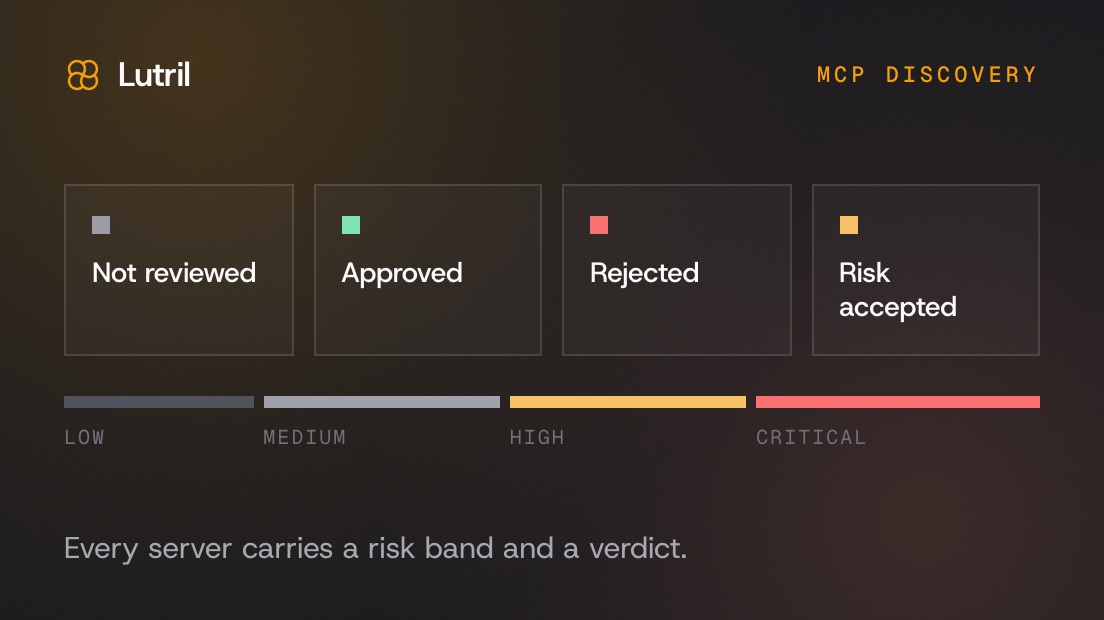
The first version of MCP Discovery answered the question we had asked first: what is out there. That turned out to be the easy half. A list of servers nobody has ruled on is an inventory, and an inventory is not governance.
So the screens now lead with the decision. Every server carries two things side by side: a risk band computed from the signals the agent reported, and a review state. The states are the four a security team actually uses, not reviewed, approved, rejected and risk accepted. The last one matters as much as the others, because a tool that only lets you approve or reject pushes people into approving things they have reservations about, and the reservation is the part worth recording.
The risk band comes from scoring, not from a vibe. Each signal carries a weight, the weights live in the backend rather than in the agent, and the bands sit at fixed thresholds. That split is deliberate: re-scoring an entire fleet against a new weighting is a backend deploy, not a binary you have to push to every laptop again.
From the same screen, a remote server can be taken over behind the MCP gateway in one click, which turns a discovered server into a governed one without anybody touching a config file. Servers that run on the machine itself stay approval only, because there is no gateway to put in front of them.