Secrets and personal data stop at the gateway
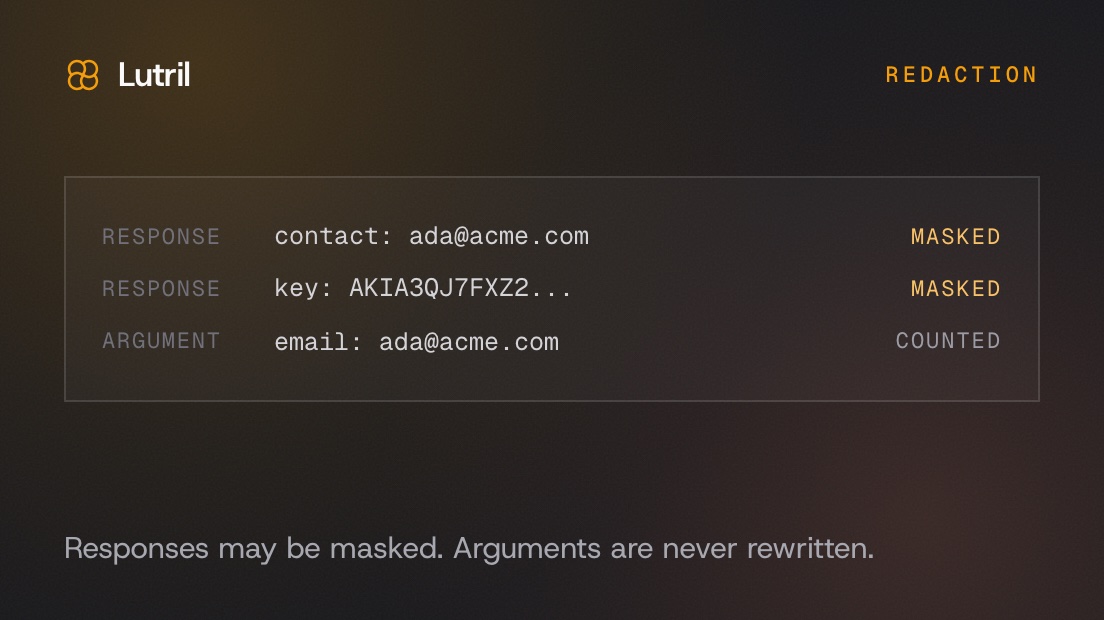
Arguments got shape validation, responses got a size ceiling, and between the two the bytes were opaque. A vendor response carrying a customer's email address, or an AWS key somebody had once pasted into a ticket, went straight into a third-party model's context and stayed there.
The two directions are deliberately not symmetric, and the asymmetry is the whole design. A response may be masked, because masking only narrows what the model is told: the worst case is a less useful answer, the best case is a secret that never left the perimeter. An argument is never rewritten. Replacing an email inside an update call would send the vendor a different instruction than the caller gave, the write would land on the wrong record silently, and the audit would show a success. So an argument is counted, and refused outright in the stricter mode, but never altered.
It is off by default, per server. This sits on the hot path of every call, so a tenant that has not opted in is not affected at all. Where it is on, the whole payload is screened rather than a sample of it: the scan ceiling is set to the same size limit the wire already enforces, so there is no gap between what can arrive and what gets looked at.